
Does AI Weaken Thinking? What the Evidence Shows
The honest answer is more useful than the headlines, and it has a fix built in.

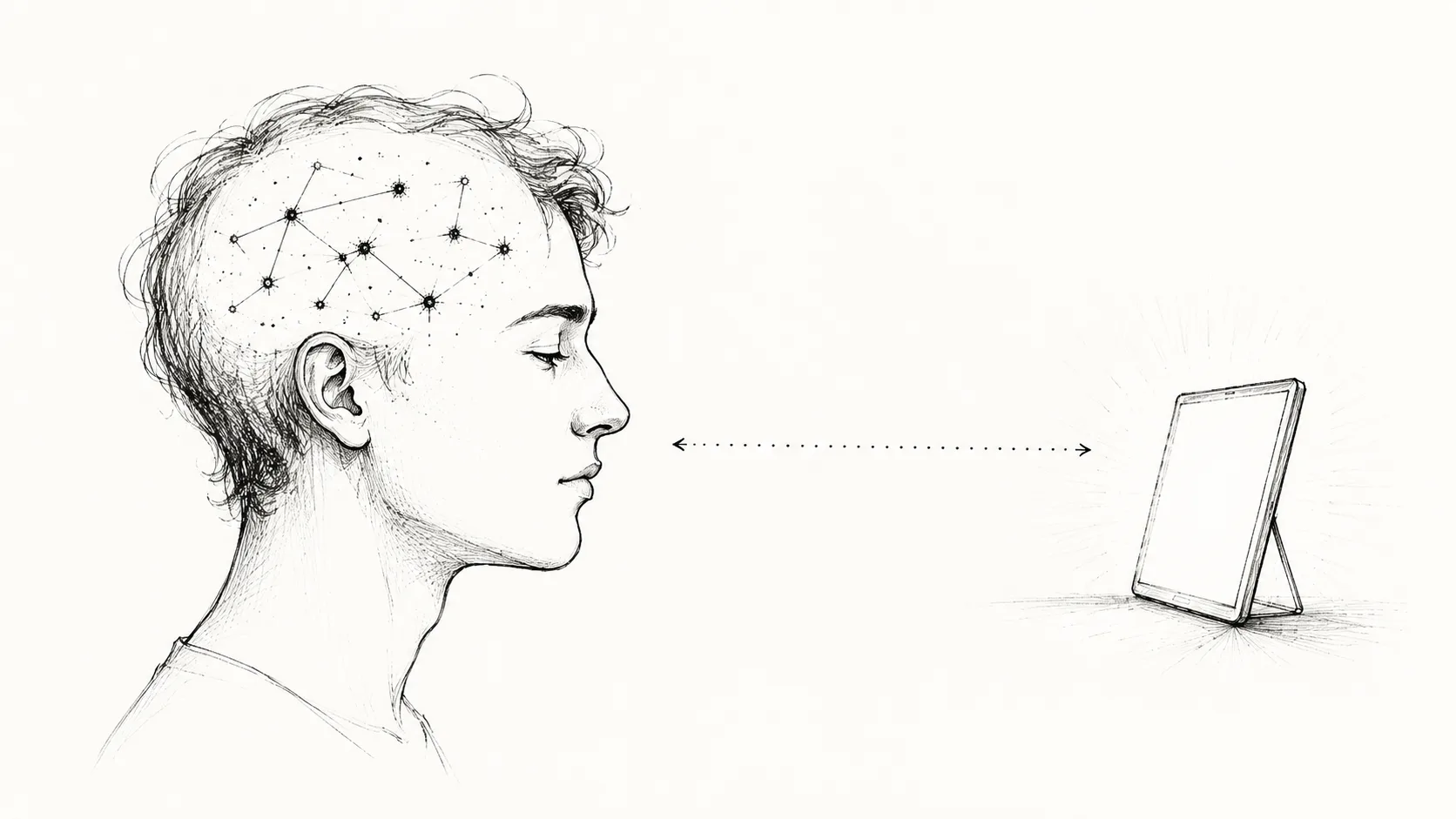
Every few weeks a headline announces that artificial intelligence is rotting our brains. A study with brain scans. A survey of students who can no longer concentrate. A warning that a generation is outsourcing its mind. The headlines are frightening, they travel fast, and they are mostly running ahead of what the evidence can actually support.
The honest answer to “does AI weaken thinking” is more useful than the panic, because it is conditional, and the condition is the whole point. Used one way, AI does measurably weaken the very capacities a university exists to build. Used another way, the same tool strengthens them. The difference is not the technology. It is what you make it do. Once you see that, the question stops being a source of dread and becomes a design decision.
First, what the evidence does not say
It is worth clearing the loudest claim out of the way, because credibility depends on it. The most viral “AI damages your brain” stories tend to trace back to a single small study that measured the brain activity of a few dozen people writing essays. It is suggestive, it has not been through peer review, and its own authors caution against reading too much into it. If you want to make the case that AI affects thinking, that is not the study to lean on, and anyone who waves it around as proof is overreaching.
The careful claim does not need the scary headline, because it rests on something much more solid.
What the solid evidence does say
Start with the one recent study that is both peer reviewed and directly on point. Researchers surveyed several hundred knowledge workers about how they actually use AI on real tasks, and found a clear pattern: the more a person trusted the machine, the less of their own critical judgement they brought to the work (Lee and colleagues, 2025). It rests on self-report, so treat it as a strong signal rather than the last word. But it points exactly where decades of established learning science already point.
That science is not about AI at all, which is why it is so reliable. It is about how minds are built. We remember less when we expect a machine to hold the information for us (Sparrow and colleagues, 2011). We learn durably through effort, not ease: retrieving an answer outlasts re-reading it (Roediger and Karpicke, 2006); explaining our own reasoning to ourselves deepens understanding (Chi and colleagues, 1989); the difficulties that feel unpleasant in the moment are often the ones that build lasting understanding (Bjork and Bjork, 2011); and wrestling with a problem before being shown the method makes the eventual understanding deeper (Kapur, 2008).
Put those together and you get the mechanism behind the worry. Thinking is built by effort. The danger of any tool that removes the effort is that it removes the thing doing the building. A machine that hands you the finished answer is, by default, an effort-removal device. That is the real basis for concern, and it is far steadier ground than a brain scan.
The study that settles the argument
Here is where the conditional comes in, and it is the most important finding in the whole debate. In a large field experiment, students were given an AI assistant for practice. The ordinary version, the one that simply gives answers, lifted their performance while they leaned on it and then left them noticeably worse on a later test they took without it (Bastani and colleagues, 2025). They felt like they were learning. They were not. But a second version of the very same tool, redesigned to withhold the answer and make the student reason first, removed the harm entirely. Separately, an AI tutor deliberately built to question rather than answer produced more than double the learning of a strong, well-run class (Kestin and colleagues, 2025).
Same technology. Opposite outcomes. The only thing that changed was whether the machine made the human think first.
That is the answer to “does AI weaken thinking”. It is: it depends entirely on how you use it, and we have the evidence to say so precisely rather than vaguely. AI used as a thing to think instead of you weakens thinking. AI used as a thing to think with strengthens it.
The tool is neutral. The posture is everything.
The part that predates AI
It is also worth being honest about the backdrop, because some of the alarm is older than the technology. Measured creative-thinking scores have been drifting down since around 1990, long before any of this existed (Kim, 2011), and measured intelligence in some populations peaked and reversed decades ago (Bratsberg and Rogeberg, 2018). AI did not cause those trends, and anyone who pins them on it is reaching past the evidence.
But here is why it still matters. AI is the most powerful engine for offloading thought ever invented, and it has arrived in classrooms and workplaces that were already finding it hard to keep people thinking. It is not the origin of the problem. It is the strongest accelerant we have ever handed it. That is precisely why how we use it is not a small question.
So what do you actually do?
You make the machine ask before it answers. That single move converts an effort-removal device into an effort-demanding one. Instead of “give me the answer”, you open with your own reasoning and instruct the machine to interrogate it: what is my argument, what is my evidence, where am I weak. Now it cannot do your thinking for you, because it has to pull your thinking out of you first. You do the work; it makes the work sharper. We call that moment, when the machine stops answering and starts questioning you, the Flip, and it is the entire method.
This is not a softer way to use AI. It is a more demanding one, and it is demanding in exactly the way the science says builds a mind: it forces you to retrieve, to generate, to explain yourself before you can move on. It puts the desirable difficulty back in, deliberately, which is the one thing the answer-machine strips out.
The honest through-line
So, does AI weaken thinking? Used to avoid thinking, yes, and the careful evidence supports that without needing a single scary headline. Used to provoke thinking, no, it does the opposite, and the careful evidence supports that too. The popular debate is stuck arguing about the tool, as though the answer were yes or no. It was always a design question. The machine will make you think less or think more depending on one choice, and the choice is yours to make. The fuller argument, and what it means for how universities should teach and assess, is on the foundational essay.
Frequently asked questions
Does AI weaken thinking?
It depends on how you use it. Used as an answer-machine that removes the effort, AI weakens the very thing effort builds, and a field experiment found students performed worse on a later unaided test after leaning on one. Used as a tool that questions you and makes you reason first, the same technology improved learning. The tool is neutral; the posture decides the outcome.
Does using AI reduce critical thinking?
A peer-reviewed study of knowledge workers found that the more people trusted AI, the less of their own critical judgement they applied. That fits a century of learning science showing that effort, not ease, builds understanding. But it is conditional: AI designed to interrogate you rather than answer you can sharpen critical thinking instead of dulling it.
Is the 'AI rots your brain' study real?
The most viral version traces to a small study of a few dozen people that has not been peer reviewed, and whose own authors caution against over-reading it. Treat it as suggestive, not proof. The careful case against mindless AI use rests on stronger ground: peer-reviewed work on knowledge workers and decades of settled learning science.
How do I use AI without it weakening my thinking?
Make it ask you questions before it answers. Bring your own reasoning first and instruct it to interrogate your argument, your evidence, and your weak points before it produces anything. That forces you to do the thinking while the machine sharpens it, which is the opposite of offloading. This move, making the machine question you first, is the core of the Havruta method.
- Bastani, H., et al. (2025). Generative AI without guardrails can harm learning. PNAS. pnas.org
- Bjork, E. L., and Bjork, R. A. (2011). Making things hard on yourself, but in a good way. bjorklab.psych.ucla.edu
- Bratsberg, B., and Rogeberg, O. (2018). Flynn effect and its reversal. PNAS. pnas.org
- Chi, M. T. H., et al. (1989). Self-explanations. Cognitive Science. onlinelibrary.wiley.com
- Kapur, M. (2008). Productive Failure. Cognition and Instruction. tandfonline.com
- Kestin, G., et al. (2025). AI tutoring outperforms in-class active learning. Scientific Reports. nature.com
- Kim, K. H. (2011). The Creativity Crisis. Creativity Research Journal. tandfonline.com
- Lee, H.-P., et al. (2025). The Impact of Generative AI on Critical Thinking. CHI '25. dl.acm.org
- Roediger, H. L., and Karpicke, J. D. (2006). Test-enhanced learning. Psychological Science. journals.sagepub.com
- Sparrow, B., et al. (2011). Google Effects on Memory. Science. science.org
This is the short version. The full argument, and what it means for how universities teach and assess, is in Havruta and the Academy.