
It Feels Like Cheating. It Isn't.
Why so many capable people feel like frauds for using AI at work, and the one line that tells you whether they should.

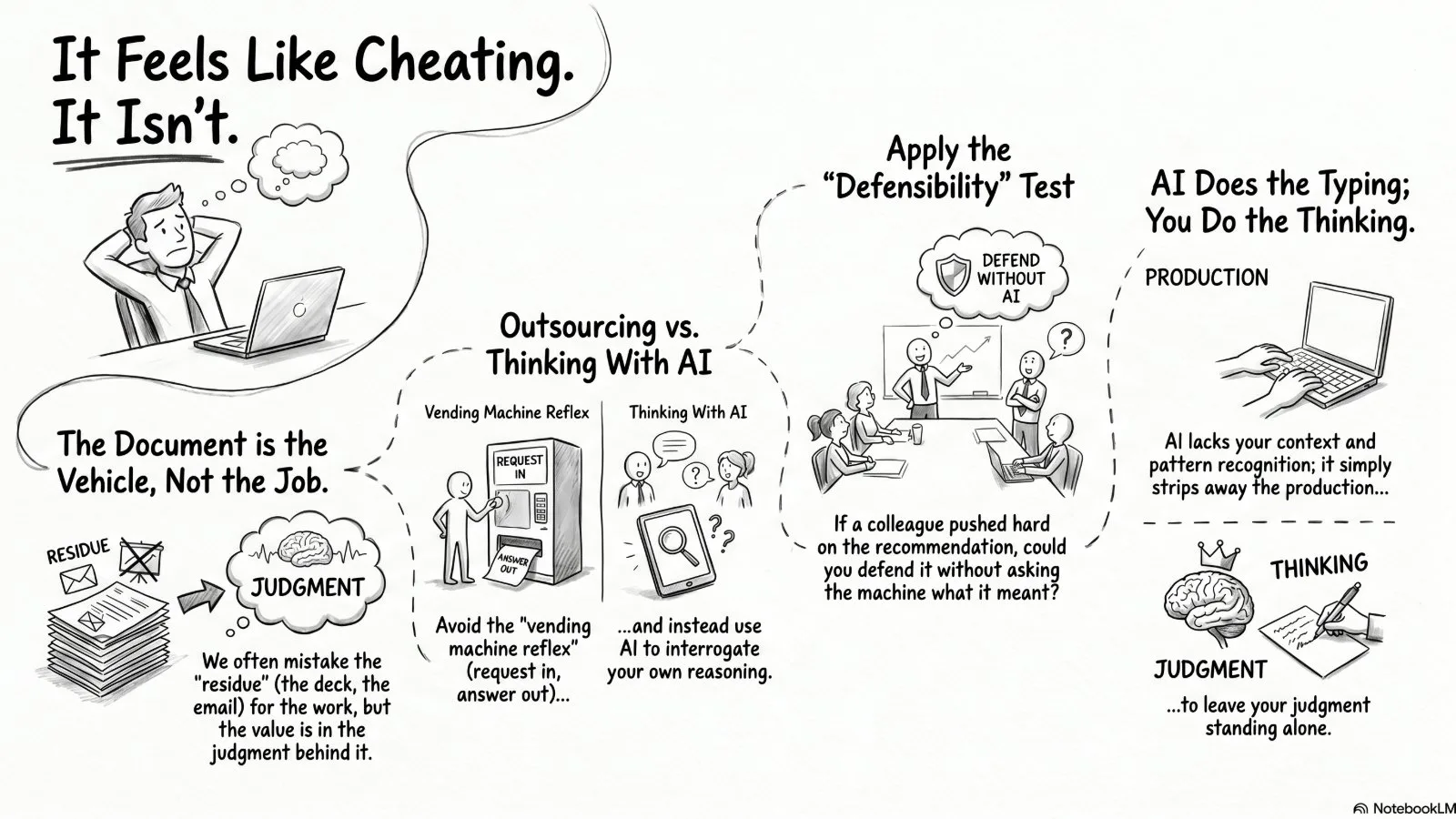
I have heard the same confession, almost word for word, from people who are very good at their jobs. They lower their voice slightly and say some version of: “I used AI to do this, and honestly, it felt like cheating.” A finance director who built a board paper with it. A marketer who drafted a strategy with it. A senior leader who prepared for a negotiation with it. Capable, experienced, well paid, and quietly uneasy, as though they had got away with something.
It is worth taking that feeling seriously, because it is widespread and it is not stupid. But it is aimed at the wrong target. The discomfort is real. The conclusion most people draw from it is wrong. So let me try to separate the two.
Where the guilt comes from
The guilt comes from a hidden belief about what your job was. Most of us absorbed, somewhere along the way, the idea that the work is the output: the document, the model, the deck, the email. You produce the artefact, the artefact is the job, and the hours you spend making it are the proof that you earned your seat.
So when a machine produces the artefact in ninety seconds, the belief quietly panics. If the document was the job, and I did not make the document, then what did I do? Did I do anything? That is the exact moment the word “cheating” arrives. It is impostor syndrome with a new trigger.
But the belief was never quite true. The document was never the job. It was the vehicle. The job was the thinking the document carried: the judgement about what mattered, the decision about what to leave out, the read on the room, the thing you know about this business that is written down nowhere. The artefact was only ever the visible residue of that thinking. We mistook the residue for the work because, until now, you could not get one without the other. AI just broke that link, and breaking it exposed how much of our sense of value was attached to the wrong thing.
Two ways to use it, and only one is a problem
Here is the distinction that decides whether your guilt is justified.
The first way is to outsource the thinking. You ask the machine for the answer, it gives you a confident, fluent one, and you tidy it and send it on. You did not bring much. You did not push back. You took the first thing it said because it sounded right. This is the vending-machine reflex: request in, answer out, move on. And if this is how you used it, the unease is telling you something true, though not what you think. You did not cheat your employer. You did something quietly worse for yourself: you made your contribution indistinguishable from anyone else's, because a generic question to a generic machine produces a generic answer. If the output could have come from anyone, you have made yourself replaceable, and some part of you can feel it.
The second way is to think with it. You bring the context, the constraints, the half-formed instinct, the thing you are worried about. You make it argue with you. It drafts, you reject it, you explain why, it tries again. You feed it what it could not possibly know, the realities of your market, your customer, your last three years of decisions, and you hold it to your standard, not its own. The work that comes out the other side is yours in the only sense that matters: nobody else could have produced it, because nobody else has your judgement or your knowledge. You used a powerful tool. You did not abdicate.
That is not cheating. That is the job, done better than you could do it alone.
The test, and it is the same one
There is a single question that tells you which of the two you did, and it is the same test that should settle the cheating question for a student or a knowledge worker alike: could you defend it?
If your colleague stopped you in the corridor and pushed hard on the work, why this recommendation and not that one, what happens if the main assumption is wrong, where is it weakest, could you answer? If you can, then whatever the machine typed, the thinking is yours, and you should feel no guilt at all. If you cannot, if you would have to go back and ask the machine what it meant, then you did not do the work, and the discomfort is a useful signal rather than a neurosis. It is not telling you to stop using AI. It is telling you that you stopped thinking.
Why “the AI did my work” is a misread
The phrase people reach for, “the AI did my work for me”, quietly misdescribes what happened. The machine does not know your business. It has never sat in your meetings, lost your deals, or carried your numbers. Most of what makes a decision good at your level is not in any document it could have read; it is in your head, undocumented, the accumulated pattern recognition of someone who has done this for years. The machine cannot do that work because it does not have the material. What it can do, extraordinarily well, is take your material and your reasoning and turn it into something faster and sharper than you could alone.
So the honest sentence is not “the AI did my work”. It is “the AI did the typing; I did the thinking, or I should have”.
The value was never in the production. It was always in the judgement.
AI has simply stripped away the production and left the judgement standing on its own, exposed, which is uncomfortable precisely because it is now the only thing you are being paid for. That is not a reason for guilt. It is a reason to get very good at the part that is actually yours.
The instinct is right. The target is wrong.
None of this is an argument that AI at work is consequence-free. The research is fairly blunt that the more people trust the machine, the less of their own critical judgement they tend to apply (Lee and colleagues, 2025). The vending-machine habit is real and it does dull you. But the same research, and plenty more, shows that used well, AI makes capable people markedly more productive without making them frauds. The tool is not the problem. The posture is.
So if using AI at work makes you feel like you are cheating, do not ignore the feeling and do not obey it either. Interrogate it. It is a good instinct pointed at the wrong target. It is not telling you that using the machine is dishonest. It is telling you, if it is telling you anything, that on this particular task you let the machine think for you, and somewhere underneath you know that thinking was the job.
The fix is the same one we install with leaders everywhere. Stop asking the machine for answers and start making it ask you questions. Open with your reasoning, not its output. Make it interrogate your assumptions before it drafts a word. (That is the method.) Do that, and the guilt evaporates, not because you have rationalised it away, but because it no longer applies. You are not getting away with something. You are doing the most valuable version of your job, with the most powerful instrument anyone has ever handed you, and bringing the one thing it will never have: you.
Frequently asked questions
Is using AI at work cheating?
It depends entirely on what you let the machine do. If you ask it for the answer and send on the first fluent thing it says, you have outsourced the thinking, and you have made your contribution indistinguishable from anyone else's. If you bring the context, the constraints and your own judgement, and make it argue with you until the work is something nobody else could have produced, that is not cheating. That is the job, done better than you could do it alone.
Why does using AI at work make me feel like a fraud?
The guilt comes from a hidden belief that the work is the output: the document, the model, the deck. When a machine produces the artefact in seconds, that belief panics and the word “cheating” arrives. But the document was never the job. It was the vehicle. The job was always the thinking it carried, and AI has simply made that judgement the only thing left standing.
Did the AI do my work for me?
Almost certainly not, in the way the phrase implies. The machine does not know your business, has never sat in your meetings or carried your numbers, and cannot supply the undocumented pattern recognition in your head. The honest sentence is not “the AI did my work”. It is “the AI did the typing; I did the thinking, or I should have”. The value was never in the production. It was always in the judgement.
How do I use AI at work without it feeling like cheating?
Stop asking the machine for answers and start making it ask you questions. Open with your reasoning, not its output, and make it interrogate your assumptions before it drafts a word. There is a single test that tells you whether the work is yours: could you defend it? If a colleague pushed hard on it in the corridor and you could answer, the thinking is yours and the guilt does not apply.
- Lee, H.-P., et al. (2025). The impact of generative AI on critical thinking. CHI '25. dl.acm.org
- Noy, S., and Zhang, W. (2023). Experimental evidence on the productivity effects of generative artificial intelligence. Science. science.org
- Brynjolfsson, E., Li, D., and Raymond, L. R. (2025). Generative AI at work. Quarterly Journal of Economics. academic.oup.com
This is the posture we install into how Fortune 500 leaders reason with AI. If that is the work you need, request a strategic briefing.